Showing posts with label InDesign. Show all posts

Monday, April 6, 2015

My Next Mountain

I teased on Facebook that I’d provide more information on the “summit” of the metaphorical mountain I had finally ascended back on March 25. It’s not the tallest peak there is, but the tallest peak I've ascended to this point in my publishing career. Now it’s time to tell you more about the climb and the view. For more background on what I’m talking about, refer to my blog post “Recording More than Just Cats” (October 28, 2014).

In a nutshell, for ten months of my LDS mission I talked about each day’s events into a tape recorder rather than writing the experiences down in a longhand journal. From 2003 to 2011, I transcribed all thirty-six hours of recordings and then edited, proofed, and added end notes to the text. In 2011, I started formatting the text in InDesign CS4. In the past twelve years I've worked on this project, there have been a few years I haven’t touched this project at all. When I have worked on it, it’s been no more than an hour at a time because of full-time employment and other conflicting priorities.


After becoming self-employed in December as a personal historian, I decided that in order for anyone—including myself—to trust me to publish anything, I'd have to have published something. I've been in the writing business for years, but I've never been the person to take a project the final steps to publication.

While at BYU, publishing opportunities slipped through my fingers in situations beyond my control. My English 318R class required me to publish a short, personal history project. After I finished it, no matter how many times I took the zip disc to the BYU Print Shop or even to Kinko’s, no one could print it. There were always problems, like missing fonts or a corrupted zip disc. In 2002, the student publication adviser chose me to be the co-editor of a student journal called Inscape: Conference Edition. Soon afterward, the English department pulled funding. Funding returned a year later—during my final semester of college, as I limped and crawled to the finish line of graduation.

While a newspaper reporter, I worked in a bureau in a separate county from the newsroom. For a single month, I worked in the newsroom. I proofed the paper each afternoon on the day prior to circulation; however, I never took part in taking it to the printer. I had a much, much larger role to play in a magazine production process at Harris Publishing; however, once again, the artist formatted the magazine and prepared it for publication, not me. That’s where my experience has stopped.

Until now.

As this year began, having taken a year or so hiatus from my missionary book project, I didn't know where I had left off. Tired of putting it together piecemeal, and while finding side jobs wherever I could, I've spent most of my time—hours per day—working on this missionary journal, which I now call My Captain’s Logs

At the beginning of February, I started proofing the entire book—five chapters and an epilogue—for the umpteenth time. I realistically cannot count how many times I've proofed this book, but I can say I've completed every step in this production process myself. I did that for the bragging rights, not because I should have.
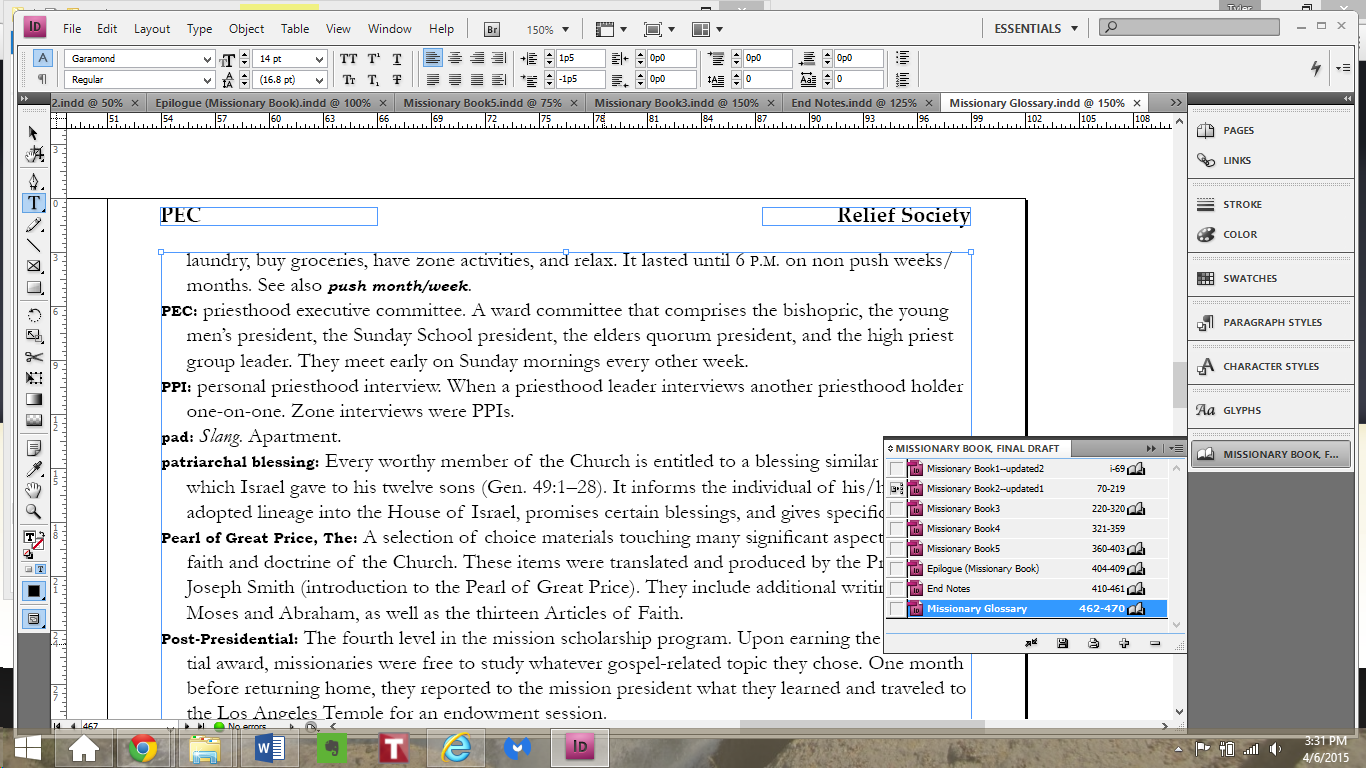

I intentionally made this project more complicated than it needed to be, partly to give me my first taste of publishing a truly professional book, and partly for the benefit of readers unfamiliar with LDS jargon. The preface explains how the project came to be. The epilogue concludes my mission between the time the final cassette ended and when my stake president released me three days later. End notes explain details or complete events I had forgotten about while recording the captain’s logs (so that those memories won’t be lost for all mortality). The glossary explains LDS jargon and missionary culture mentioned too frequently in the text to be included in the end notes.

Starting on February 4, I devoted the entire month to proofing the main text—several hundred pages—one last time. During the proofing process, I came up with scores of new end notes for every chapter I hadn't yet written that needed including. So as to not derail my proofing, I marked each spot in the text for a new end note and continued on. Once I completed proofing the book, the day after my birthday I went back and wrote all of those missing end notes—as well as even more notes I hadn't thought of while proofing it that final time—and renumbered the end notes in the Notes section and corresponding text. I also had to confirm every cross-reference I mentioned in every chapter.

At one point I felt like Lewis Carroll's Alice, metaphorically plunging down a rabbit hole. Much like picking rock in a field while growing up on a farm, the more rocks I picked the more I found. With this, the more I corrected the more needed to be verified/corrected. Once I finished writing new end notes, I proofed the end notes. And then I proofed the glossary. Then based on the sixteenth edition of The Chicago Manual of Style (2010), I corrected front matter, back matter, general formatting, and I checked for style consistency throughout the entire Book document until I finally felt satisfied with the changes I’d made. Since the day I felt I had finally reached the summit—finishing a complicated project I started twelve years ago—I've even added a few final end notes. Just this afternoon, I even revised one end note to make it more factually accurate.

Now that I stand on this summit, feeling the cool wind on my face and enjoying the spectacular view of a completed project, I look ahead to the peak rising yet above me on the next mountain over. I've already run into hiccups on my way up the new slope—the website of a book printer based in Caldwell, Idaho, won’t even let me send them a quote request, which I've attempted several times. I’m still working on it.

My plan is to have it printed, bound, and delivered no later than the sixteen anniversary of my release from my mission (June 23). I’ll distribute those ten or so copies to family members and mission friends. Like I mentioned in my blog post in October, if you want a copy let me know. Donations will be gladly appreciated.

However, you’ll notice—after the countless hours and years of manpower I've poured into this book—it doesn't even have an index or an ISBN number.


I’m saving those for the second edition.

Tuesday, October 28, 2014

Recording More than Just Cats

It started with a Fisher-Price tape recorder in the 1980's, continued with a GE cassette recorder in the 1990's, and has culminated (at this point in the 21st Century) with a Sony IC digital recorder.

I've been recording stuff for most of my life.

When it was a Fisher-Price tape recorder, I recorded random things. I mean, really random. I recorded bad attempts at playing the piano. I recorded the theme during the end credits to the TV show “The A-Team.” I once accidentally recorded someone’s flatulence. (That never stopped being funny.) I even “interviewed” our pets—our bobbed-tail cat, Bobbie, and our Springer Spaniel-Australian Shepherd mix dog, Bernie. I acted like they were answering coherently.

Parenthetically, I have to mention that I lived a mile outside of a town of 1,200 people. This was before we got a Nintendo Entertainment System. We didn't have a VCR yet. There was no such thing as the Internet or smartphones. We actually used our imaginations back in the 1980's. Dang kids today.

Many years after I forgot about the Fisher-Price tape recorder, my parents gave me a gray GE tape recorder for Christmas. After once again using it to record random things—like my friends and I being stupid teenagers—I found a practical use for it while serving an honorable, full-time mission for The Church of Jesus Christ of Latter-day Saints from 1997–1999. While I wrote home to my parents nearly every week, three different times I recorded and sent a cassette letter home. That way my parents could hear my voice more often than just twice a year (Mother’s Day and Christmas).

In August of 1998, I found an even more valuable use for it. I had been keeping a written journal since December 1987. When I was nearly 10 years old, I had plenty of time but very little desire to write in it regularly; over 10 years later, it was the opposite—I had plenty of desire to write but very little time. I was serving as the “zone leader B” in the Walnut Zone of the California Arcadia Mission. That meant I was not only supposed to help the “zone leader A” with missionary work in the Orangewood Ward and Samoan wards in the Walnut California Stake, but I was also a “district leader” over two other missionary companionships and was in charge of the zone paperwork that had to be faxed weekly to the mission office in Arcadia.

My schedule reached a point where I hardly had time to write in my journal anymore. I barely had time to study the scriptures! I needed a new method of recording the day’s events and feelings, and so on Aug. 20 I resorted to using a tape recorder in lieu of a longhand journal.

For exactly 10 months to the day, I would record the day’s events—sometimes in the mornings, sometimes at night—nearly every day. I called it my “captain’s logs.” (I was and still am a Star Trek fan.) Every so often I’d miss a day or two, and so I’d have to play catch-up the next time. But I kept it up and kept purchasing blank cassette tapes—sometimes 60-minute tapes, sometimes 90-minute tapes—until my last cassette tape ran out two days before I was scheduled to return home.

While recording my captain's logs, I never concerned myself with what I was going to do with all them when I returned home. I just kept at it. When I left southern California on June 22, 1999, I had a total of 27 cassettes that were completely full—nine 60-minute tapes and eighteen 90-minute tapes, making a total of about 36 hours of recordings. At home, the longhand journals resumed.

In 2003, I finally figured out what I was going to do with all these recordings. While taking Oral History at BYU, I found a man on campus selling used transcribing machines he had fixed. I bought an old Sony industrial model—probably older than me—with a foot pedal, for $250. It’s been worth every penny.

In the 11 years since then, working on my “missionary book” has been a luxury. With most of my focus on jobs, church callings and family, there have been periods of a year or two when I wouldn't touch it. Other times, I worked on it almost daily. Over the years, I've transcribed all 27 cassettes, and edited, proofed, added end notes and proofed my missionary book again. After a long hiatus, the right time and opportunity came along in 2011 to purchase a relatively cheap but licensed copy of Adobe’s InDesign CS4. I've formatted it piecemeal, using my limited understanding of InDesign and even more limited graphic design talent. (Refer to my last blog entry. I'm the guy who only got one talent.)

As of yesterday, I’m so close to publishing it and yet so far. Yesterday, I started rearranging the end notes from where I had placed them at the end of each chapter to the back of the book (per the fourteenth edition of the Chicago Manual of Style). To those of you who know InDesign, that means I have a lot of residual problems that now need to be fixed. I also have to finish the front matter and add back matter, such as an index. At this point, this monstrosity is already approaching 500 pages. 

It’s not the kind of book you publish to sell; I’m publishing it so I can have that 10 months of my life on paper and so I can finally understand the entire publishing process—from raw manuscript to polished book. When it’s finally published, I’m only going to print about 10 copies or so. If I interacted with you as a missionary in the California Arcadia Mission, you may want to order an advanced copy from me. Because I probably talked about you.

But I promise I never recorded anyone’s flatulence.

Tuesday, September 16, 2014

My Journal Trek

If there's anything about which I can honestly say, “I'm the expert,” it has to be journal writing. When I tell people how many journals I have, the short answer is “more than 40.” The long answer is, well, long.

This is my Journal Trek.

One December evening, when I was three months shy of turning 10 years old, I noticed my mother had been keeping a journal. I don't know where the desire came from—whether it was because I was my mother's son, because I've always loved writing or because I was a kid who wanted what someone else had—but suddenly I wanted one, too. It was late enough at night in a small town that there wasn't a snowball’s chance in Hades I’d be able to buy one anywhere that night. But instead of reassuring that she’d go buy one the next day, she retrieved an extra, unused journal from her room and gave it to me. Fueled by instant gratification, I wrote almost a full page that night for my very first journal entry.

I made the commitment to write in it once a week—every Monday night. As tedious tasks tend to do when you’re a kid, my commitment eventually started eroding away. It became a self-inflicted chore. I would write randomly about things important to me as a kid, such as the latest Nintendo games, losing at whatever, and being picked on in school. Eventually I got so sick of writing that instead of merely quitting I started “cheating”—for several pages, I wrote large letters that covered several lines at a time. It culminated with one page filled with nothing but “Nothing happened. And nothing ever will!”

Because it was an intuitive obligation, I never actually gave it up. After that page, I started taking it a little more seriously. I wrote here and there and confined my writing to one line at a time (as you do). Then in high school, as a sophomore at North Fremont High School in Ashton, Idaho, my journal writing officially became a hobby the night of my first date.

While only a sophomore, I weaseled my way into the Prom by asking a senior—my best friend’s oldest sister. I was fortunate enough to be part of a date group with juniors and seniors I looked up to—two of whom, I had noticed during play practices earlier in the year, were avid journal writers. I took them as examples and decided to make my first date eternally memorable. Prior to leaving for the dance, I sat on my bed and wrote five pages about the day’s excursions—more than I had ever written before in one sitting. That wasn't even the dance itself. When I finished writing about that entire day, it covered eight pages. From then on, entries became pages long because I felt the need to include as many details as possible, even for events more mundane than the Prom.

At least until I became an adult and started learning the meaning of the word “busy.”

While serving an honorable full-time mission for the LDS Church in southern California in the late 1990’s, I became so busy 14 months into my two-year service that I abandoned the longhand journal and took up a tape recorder. I recorded entries night and morning for 10 months—to the day. I resumed writing in longhand journals after returning to Idaho, but it eventually came to a dead halt in March of 2010. Halfway through Journal #40 (which didn't include the longhand journal I kept the first 14 months of my mission), the pain of writing longhand convinced me to use a website called LDSJournal.com. That website tragically died in May of this year by starvation (i.e., lack of advertising).

Since then, Microsoft Word has been my official journal medium, but even that needs an asterisk.

Since adulthood, I've gotten into a vicious cycle of getting behind and catching up. I usually catch up but then get progressively further and further behind. At this point, it has been years since I've been current on my official journal keeping. Every day I write notes in a journal notebook, with the intention I’ll type them up in my official journal; however, as of right now, I've only made it to May of 2013. I also have a hole in the summer of 2009 because I haven’t transferred those notes to a journal yet. I also haven’t finished writing journal notes from about a week of travelling last month.   

And then there's my missionary cassette tapes from the last 10 months of my mission, which I call my “missionary book” (not missionary journal). After being confined to audio form for four years, I took an Oral History course at Brigham Young University in Provo, Utah, and obtained a Sony industrial transcribing machine. With it, over the course of several years, I single-handedly transcribed every single hour I had recorded in 10 months—36 hours on 27 cassettes—and edited, added end notes, proofed, and formatted it in Adobe InDesign. As of right now, it needs to be indexed, proofed one last time, and then published.

So because I don’t have enough writing to do, I’m going to do some “Journal Trekking” on this blog site. Every so often, I’ll publish excerpts from publicly available journals, as well as my own and my paternal grandfather’s journal notes.

What’s your Journal Trek?