Showing posts with label personal history. Show all posts

Tuesday, March 15, 2016

What I Learned from my Memory Whack-a-Mole Project

Last week I experimented on a new way to catch up on journaling, inspired by former Utah governor Michael Leavitt’s Thousand Stories project. In an attempt to come up with more anecdotes for his speeches, Leavitt sat down and wrote only a few words—one line—for each story he could remember. Then he decided to shoot for a hundred stories, which, over time, morphed into a thousand.
My project consisted of writing only a few words about each day on a February 2016 calendar until each day was covered, and then adding details as I remembered them until it could be transferred over and completed in a more permanent journal format. Because of the way memories seem to pop up at random, I decided to call my project Memory Whack-a-Mole.
I wasn’t able to complete February 2016 by the end of the week, but it was a fantastic start and I’m still pleased with the results so far.

My Observations
I’ve learned a few things from my maiden voyage, but I have a few caveats to add.
Each day last week, I got up at 5 a.m. and wrote in my daily journal, and then I worked on my Memory Whack-a-Mole—which was essentially catching up in my journal for the month of February. Now, I had already kept a sporadic journal throughout February, but when I commenced this Whack-a-Mole project last week, I started from scratch.
Basically, I wrote in my journal twice a day last week. Add on top of that revising my upcoming e-book on journal writing (called Old School Blogging, to be published in the next couple months), as well as attempting to write 1,500 words a day on the first draft of my third novel manuscript in a fantasy trilogy (more on that in another blog entry). That means by Saturday I was getting burned out from all the writing.
I found that last week’s techniques sparked memories I hadn’t written in my daily February journal entries; however, there were also details I wrote in my February journal entries I hadn’t remembered while writing in last week’s project.
My greatest word count for Memory Whack-a-Mole came from writing about the first week of February because that was the most memorable week; however, in my regular journal writing, I didn’t write much about that week for the same reason: because it was so memorable—and packed. Being the week of RootsTech 2016, I had the least amount of time—and/or focus—to devote to writing in my journal, but it took the least amount of effort to remember it.

The Takeaway
The whole point of Memory Whack-a-Mole is to make journal writing possible and easier if you're not keeping up with it.
If you don’t keep a journal but want to, start today by writing about yesterday. Then tomorrow, do the same thing you did today, except designate a specific time each day for journal writing. Then do it every day at that designated time.
Starting a worthwhile habit is the easy part; continuing on with it until it becomes habitual is what’s hard. Even if you make the time to write in your journal every day, because not all days are created equal there will be days you don’t touch your journal at all because of conflicting, escalated priorities. Once you miss a day, it’ll be easier to miss the next day and slightly more difficult to catch-up. Then it becomes a slippery slope.
You need to have at least one day per week when you don’t think about or do work at all, when you have time for quiet reflection. If you work six to seven days a week, I give you my deepest sympathies and hope you can reach a point in your life to have at least one day off per week from anything involving work so you can have time for quiet reflection.
For me, that time is Sunday afternoons, after I’ve returned home from church, eaten, and snuck in a much-needed nap. Then my schedule is open enough for me to sit down at my laptop and start writing freely in my journal. Find what time each week is best for you and stick with it.

Don’t give up on something as important in the long-term as journaling, but for those times you find yourself having lived an entire month without having recorded it, Memory Whack-a-Mole is a new technique to help you prime your memory and write about the past.

Friday, March 4, 2016

Memory Whack-A-Mole

Lately, I’ve been focusing on revising my first e-book, tentatively called Old School Blogging: Getting Back to the Art of Journal Writing. The purpose of that book is to help people put a greater emphasis on journal writing—regularly keeping a journal and improving upon their writing.

After floundering with the manuscript at the close of 2015, I found new inspiration in February by attending RootsTech 2016 in Salt Lake City, Utah. With this year’s conference theme being story-telling, I had a fresh spring to draw ideas from for not only Old School Blogging but also my personal history business.

During his keynote address, former Utah governor Mike Leavitt (1993–2003) polled the audience on governor-era stories they wanted to hear him tell. Those anecdotes included the time the governor’s mansion caught on fire, when he was chosen by Pres. George W. Bush to serve as the EPA administrator, when he informed his female lieutenant governor she would be the first female governor of Utah, and experiences revolving around the 2002 Olympics. Some stories were humorous while others were poignant to the point of bringing the audience to tears.

It was all thanks to his Thousand Stories project.

It started the day Leavitt realized he drew on the same well of stories for his speeches. One Sunday afternoon, he took out a pad of paper and starting filling the page with anecdotes from his life. Instead of painstakingly writing down explicit details, he just wrote a few words for each story—making up only a line. He reported that a few words would remind him of events in his life. After about ten minutes, he felt like he was going somewhere.

“That was fairly easy,” he thought. “I wonder if I could do a hundred?”

After a short period of time, he reached a hundred stories. Then he decided to shoot even higher by writing down a thousand stories from his life—thus giving birth to his Thousand Stories project. For inspiration, Leavitt drove through the city of his birth—Cedar City, Utah—where he found himself flooded with memories of stories to write down.

“Before I knew it,” he says, “I had a thousand story lines.”

He put the project aside for a while, letting the stories marinate a bit, until he returned to the project and started categorizing the stories. As a result, Leavitt says he “tricked” himself into writing his own personal history, which has been an enjoyable and rewarding experience for him—especially as he hears his grandchildren treasure his lifetime stories as their favorite bedtime stories.

In my own journal writing—which has added up to a ballpark number of 10,000 pages of entries in thirty-eight yearsI’ve had to play “catch-up” most of the past twenty years. I’ve found that’s been the easiest when I don’t try to catch up on strictly one day, but rather write down a line or two about each day that I remember and then go back to days I've written about. Suddenly, more memories pop into my head about a particular day, and I write it down. Then memories from another day pop into my head and I furiously write those down. Then it happens again with another day. Next thing I know, I’m playing Memory Whack-a-Mole.

Games are no fun when you don’t have anyone to play with, so my challenge to you all is to join me for Memory Whack-a-Mole next week.

Before Monday, google “February 2016 calendar” and print out the one you prefer. Make sure to use a calendar that gives you plenty of room to write a few words for each day about something you remember, whether an event, how you felt about something, or what the weather was like. And no excuses on it being the worst month of the year. On Leap Day, I asked my children around the table what their favorite part of February was. My eleven-year-old daughter said, “Dr. Seuss Day.” My nine-year-old daughter said, “Groundhog Day.” My seven-year-old said, “Valentine’s Day.” I said, “President’s Day,” because our family hit the road for a quick trip to Utah for the day.

Starting on Monday, March 7, and continuing through Sunday, March 13, make the time to sit down at a table or desk with your calendar and start writing a few words about each day, Gov. Leavitt-style. Once you’ve filled each day with a few words, go back and start expanding on them as memories pop into your mind. Once the entire calendar is filled up, migrate it all over to a more permanent format, such as a journal, a digital note-taking app like Evernote, word processing software like Word, or even a blog—some format for your budding stories to continue growing. Leavitt mentioned in his keynote address that “it wasn’t pretty,” so don’t expect your stories to be worthy of sharing in front of an audience of thousands. Just expect it to be by bringing it to life.

On Monday, March 14, join me on Facebook to report how it went. Was it fulfilling? Did you remember events you’ve already forgotten? Did it bring up memories you wanted to bury, or was February a better month than it seems?

I look forward to hearing from as many people as possible. If you haven't been keeping a journal, now is your time to start.

See you all on Monday!

Monday, January 18, 2016

Who Died Today?

What do David Bowie, David Margulies, Alan Rickman, Dan Haggerty, and Glenn Frey all have in common?

According to Worldometers, they are among the roughly three million people who have died since this month (and year) began.

Because these people were all celebrities—Ziggy Stardust, the mayor on Ghostbusters, Professor Snape, Grizzly Adams, and a founding member of The Eagles—their deaths were noticed by the masses. And the fact that they all departed within the same seven days of each other has sent Americans into a frenzy of social media sendoffs.

But again, three million more people have passed through the same mortal portal since the Gregorian calendar changed from 2015 to 2016.

While it’s slightly alarming to think the number of deaths in over two weeks is the equivalent of 79% of the entire population of Los Angeles, about seven million people have been born since the month/year began. That’s about 82% of the population of New York City replacing them in the same amount of time.

So what does it mean? It means that while seven million people have begun the exciting but difficult journey of life this month, the stories of three million others have come to an abrupt end, whether expected or unexpected. Whether accidental, intentional, or natural. Whether their stories were written down or not.

A few months ago, I started interviewing a 71-year-old mother/grandmother/farmer about her life’s history. The three interviews I’ve conducted—so far—have each lasted two hours a piece, making over six hours of recording on her life. The single-spaced transcript, in Word, so far has the word count of a novel—over 50,000 words. But to put it another way, this 71-year-old has only filled 99 pages—making not quite a page and a half for every year she’s lived. I know for a fact her life’s story could fill volumes. As it is, I have a grocery list of questions I still haven’t yet asked her.

While she’s still recovering from recent shoulder surgery, her health is fair—besides the aches and pains that accompany being a septuagenarian. And yet anything could happen. Cancer could quickly invade her body—which it has done to countless people in the area. A car accident could snuff out her life. I have another interview scheduled with her this week, and I can't wait, especially now that I realize at least three of the celebrities who died this past week were younger than she is.

So her story must continue to be told. And so should yours.

So who died today? A lot of people. Make sure that you give your loved ones an extra-long hug today and ask them to tell you about the story of their lives. Because you may not see them again tomorrow.

Monday, April 6, 2015

My Next Mountain

I teased on Facebook that I’d provide more information on the “summit” of the metaphorical mountain I had finally ascended back on March 25. It’s not the tallest peak there is, but the tallest peak I've ascended to this point in my publishing career. Now it’s time to tell you more about the climb and the view. For more background on what I’m talking about, refer to my blog post “Recording More than Just Cats” (October 28, 2014).

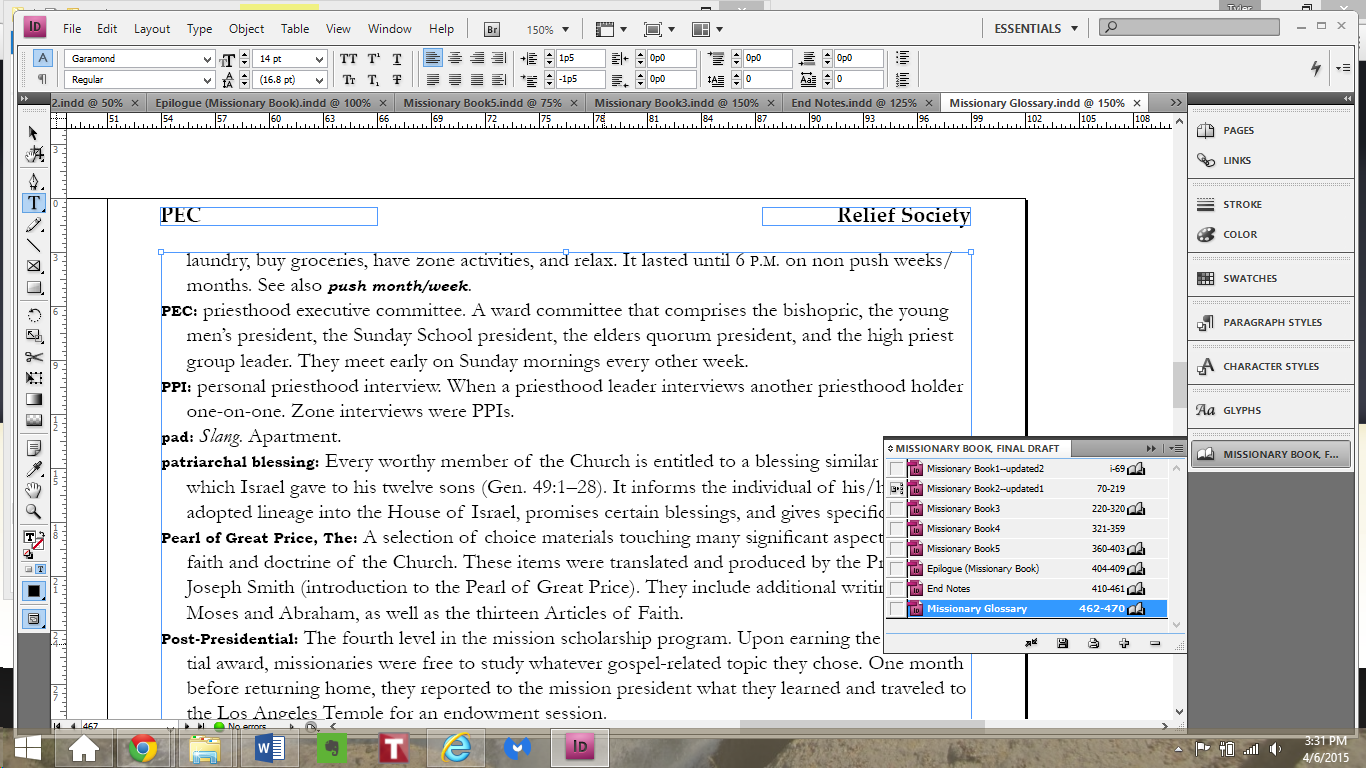
In a nutshell, for ten months of my LDS mission I talked about each day’s events into a tape recorder rather than writing the experiences down in a longhand journal. From 2003 to 2011, I transcribed all thirty-six hours of recordings and then edited, proofed, and added end notes to the text. In 2011, I started formatting the text in InDesign CS4. In the past twelve years I've worked on this project, there have been a few years I haven’t touched this project at all. When I have worked on it, it’s been no more than an hour at a time because of full-time employment and other conflicting priorities.


After becoming self-employed in December as a personal historian, I decided that in order for anyone—including myself—to trust me to publish anything, I'd have to have published something. I've been in the writing business for years, but I've never been the person to take a project the final steps to publication.

While at BYU, publishing opportunities slipped through my fingers in situations beyond my control. My English 318R class required me to publish a short, personal history project. After I finished it, no matter how many times I took the zip disc to the BYU Print Shop or even to Kinko’s, no one could print it. There were always problems, like missing fonts or a corrupted zip disc. In 2002, the student publication adviser chose me to be the co-editor of a student journal called Inscape: Conference Edition. Soon afterward, the English department pulled funding. Funding returned a year later—during my final semester of college, as I limped and crawled to the finish line of graduation.

While a newspaper reporter, I worked in a bureau in a separate county from the newsroom. For a single month, I worked in the newsroom. I proofed the paper each afternoon on the day prior to circulation; however, I never took part in taking it to the printer. I had a much, much larger role to play in a magazine production process at Harris Publishing; however, once again, the artist formatted the magazine and prepared it for publication, not me. That’s where my experience has stopped.

Until now.

As this year began, having taken a year or so hiatus from my missionary book project, I didn't know where I had left off. Tired of putting it together piecemeal, and while finding side jobs wherever I could, I've spent most of my time—hours per day—working on this missionary journal, which I now call My Captain’s Logs

At the beginning of February, I started proofing the entire book—five chapters and an epilogue—for the umpteenth time. I realistically cannot count how many times I've proofed this book, but I can say I've completed every step in this production process myself. I did that for the bragging rights, not because I should have.


I intentionally made this project more complicated than it needed to be, partly to give me my first taste of publishing a truly professional book, and partly for the benefit of readers unfamiliar with LDS jargon. The preface explains how the project came to be. The epilogue concludes my mission between the time the final cassette ended and when my stake president released me three days later. End notes explain details or complete events I had forgotten about while recording the captain’s logs (so that those memories won’t be lost for all mortality). The glossary explains LDS jargon and missionary culture mentioned too frequently in the text to be included in the end notes.

Starting on February 4, I devoted the entire month to proofing the main text—several hundred pages—one last time. During the proofing process, I came up with scores of new end notes for every chapter I hadn't yet written that needed including. So as to not derail my proofing, I marked each spot in the text for a new end note and continued on. Once I completed proofing the book, the day after my birthday I went back and wrote all of those missing end notes—as well as even more notes I hadn't thought of while proofing it that final time—and renumbered the end notes in the Notes section and corresponding text. I also had to confirm every cross-reference I mentioned in every chapter.

At one point I felt like Lewis Carroll's Alice, metaphorically plunging down a rabbit hole. Much like picking rock in a field while growing up on a farm, the more rocks I picked the more I found. With this, the more I corrected the more needed to be verified/corrected. Once I finished writing new end notes, I proofed the end notes. And then I proofed the glossary. Then based on the sixteenth edition of The Chicago Manual of Style (2010), I corrected front matter, back matter, general formatting, and I checked for style consistency throughout the entire Book document until I finally felt satisfied with the changes I’d made. Since the day I felt I had finally reached the summit—finishing a complicated project I started twelve years ago—I've even added a few final end notes. Just this afternoon, I even revised one end note to make it more factually accurate.

Now that I stand on this summit, feeling the cool wind on my face and enjoying the spectacular view of a completed project, I look ahead to the peak rising yet above me on the next mountain over. I've already run into hiccups on my way up the new slope—the website of a book printer based in Caldwell, Idaho, won’t even let me send them a quote request, which I've attempted several times. I’m still working on it.

My plan is to have it printed, bound, and delivered no later than the sixteen anniversary of my release from my mission (June 23). I’ll distribute those ten or so copies to family members and mission friends. Like I mentioned in my blog post in October, if you want a copy let me know. Donations will be gladly appreciated.

However, you’ll notice—after the countless hours and years of manpower I've poured into this book—it doesn't even have an index or an ISBN number.


I’m saving those for the second edition.

Tuesday, October 28, 2014

Recording More than Just Cats

It started with a Fisher-Price tape recorder in the 1980's, continued with a GE cassette recorder in the 1990's, and has culminated (at this point in the 21st Century) with a Sony IC digital recorder.

I've been recording stuff for most of my life.

When it was a Fisher-Price tape recorder, I recorded random things. I mean, really random. I recorded bad attempts at playing the piano. I recorded the theme during the end credits to the TV show “The A-Team.” I once accidentally recorded someone’s flatulence. (That never stopped being funny.) I even “interviewed” our pets—our bobbed-tail cat, Bobbie, and our Springer Spaniel-Australian Shepherd mix dog, Bernie. I acted like they were answering coherently.

Parenthetically, I have to mention that I lived a mile outside of a town of 1,200 people. This was before we got a Nintendo Entertainment System. We didn't have a VCR yet. There was no such thing as the Internet or smartphones. We actually used our imaginations back in the 1980's. Dang kids today.

Many years after I forgot about the Fisher-Price tape recorder, my parents gave me a gray GE tape recorder for Christmas. After once again using it to record random things—like my friends and I being stupid teenagers—I found a practical use for it while serving an honorable, full-time mission for The Church of Jesus Christ of Latter-day Saints from 1997–1999. While I wrote home to my parents nearly every week, three different times I recorded and sent a cassette letter home. That way my parents could hear my voice more often than just twice a year (Mother’s Day and Christmas).

In August of 1998, I found an even more valuable use for it. I had been keeping a written journal since December 1987. When I was nearly 10 years old, I had plenty of time but very little desire to write in it regularly; over 10 years later, it was the opposite—I had plenty of desire to write but very little time. I was serving as the “zone leader B” in the Walnut Zone of the California Arcadia Mission. That meant I was not only supposed to help the “zone leader A” with missionary work in the Orangewood Ward and Samoan wards in the Walnut California Stake, but I was also a “district leader” over two other missionary companionships and was in charge of the zone paperwork that had to be faxed weekly to the mission office in Arcadia.

My schedule reached a point where I hardly had time to write in my journal anymore. I barely had time to study the scriptures! I needed a new method of recording the day’s events and feelings, and so on Aug. 20 I resorted to using a tape recorder in lieu of a longhand journal.

For exactly 10 months to the day, I would record the day’s events—sometimes in the mornings, sometimes at night—nearly every day. I called it my “captain’s logs.” (I was and still am a Star Trek fan.) Every so often I’d miss a day or two, and so I’d have to play catch-up the next time. But I kept it up and kept purchasing blank cassette tapes—sometimes 60-minute tapes, sometimes 90-minute tapes—until my last cassette tape ran out two days before I was scheduled to return home.

While recording my captain's logs, I never concerned myself with what I was going to do with all them when I returned home. I just kept at it. When I left southern California on June 22, 1999, I had a total of 27 cassettes that were completely full—nine 60-minute tapes and eighteen 90-minute tapes, making a total of about 36 hours of recordings. At home, the longhand journals resumed.

In 2003, I finally figured out what I was going to do with all these recordings. While taking Oral History at BYU, I found a man on campus selling used transcribing machines he had fixed. I bought an old Sony industrial model—probably older than me—with a foot pedal, for $250. It’s been worth every penny.

In the 11 years since then, working on my “missionary book” has been a luxury. With most of my focus on jobs, church callings and family, there have been periods of a year or two when I wouldn't touch it. Other times, I worked on it almost daily. Over the years, I've transcribed all 27 cassettes, and edited, proofed, added end notes and proofed my missionary book again. After a long hiatus, the right time and opportunity came along in 2011 to purchase a relatively cheap but licensed copy of Adobe’s InDesign CS4. I've formatted it piecemeal, using my limited understanding of InDesign and even more limited graphic design talent. (Refer to my last blog entry. I'm the guy who only got one talent.)

As of yesterday, I’m so close to publishing it and yet so far. Yesterday, I started rearranging the end notes from where I had placed them at the end of each chapter to the back of the book (per the fourteenth edition of the Chicago Manual of Style). To those of you who know InDesign, that means I have a lot of residual problems that now need to be fixed. I also have to finish the front matter and add back matter, such as an index. At this point, this monstrosity is already approaching 500 pages. 

It’s not the kind of book you publish to sell; I’m publishing it so I can have that 10 months of my life on paper and so I can finally understand the entire publishing process—from raw manuscript to polished book. When it’s finally published, I’m only going to print about 10 copies or so. If I interacted with you as a missionary in the California Arcadia Mission, you may want to order an advanced copy from me. Because I probably talked about you.

But I promise I never recorded anyone’s flatulence.

Tuesday, September 30, 2014

My Grandma is Better than Your Grandma

On Nov. 30, 2002, I conducted my very first interview. It wasn't as a newspaper reporter or as a magazine editor—I've conducted countless hours of those interviews since. This one was special, not only because it was my first, but because the subject was my maternal grandmother—Georgia Cordingley Oberhansley.

It was during the Thanksgiving break prior to my last semester at Brigham Young University. I had found out earlier that month that one of the options for Senior Courses the next semester—among mind-numbing literature classes and linguistics classes—included Oral History. Even though I had never tasted of oral history before, it had jumped out at me so fiercely that I scheduled an interview before the semester even started.

(As it turns out, that was a smart idea anyway. Since my grandmother was over 300 miles away from campus—and because there isn't ONE SINGLE day off from classes during BYU's Winter semesters because they have to pack so many events on campus after the Winter semester concludes and before the next Fall semester ends—that I couldn't have interviewed her in person after the semester started. Sorry. Rant over.)

Grandma Georgia didn't divulge very many details during that interview, but she told me a lot more than I had heard before. While I had always loved and adored Grandma Georgia, after the interview was over I almost worshiped her. I literally have the greatest grandmother in the world. Anyone who says different is wrong. Here’s why:

Georgia Cordingley grew up as a country girl, in a quaint little town called Marysville, Idaho, a mile east from the town of Ashton. While attending high school in Ashton, she met my grandfather—Wayne Alvin Oberhansley—who was boxing a cousin of hers during the boxing match. In the interview she says, “He really took my eye then,” but since then she’s told me a little more about the match. Apparently, Wayne was doing such a good job that she “enjoyed watching him beat the hell out of” her cousin.

He caught her eye then, but after his family moved from St. Anthony to nearby Farnum, she started to fall for him—and became good friends with his sister, Maydea. One day, the two friends wanted to go roller skating in St. Anthony. Georgia asked Wayne. Wayne’s sister, Maydea, and Georgia’s brother, Hollis, went with them. Then at the roller skating rink, Grandma and Grandpa ditched their siblings and went on a drive. They lost track of time. When they came back, the rink was already closed and it was starting to rain. Their siblings weren't happy. Oops.

Grandpa was drafted into the Marines when he was 19 and fought in World War II. (That’ll be the subject of a future blog post.) After he returned, he proposed and the two were married in 1947.

Then they started having kids.

Their first, my mother, LaDawn, was born on Mother’s Day in 1948. The second, Dennis, was born 12 months later. Then identical twins—Garth and Gary—were born about two and a half years after that, making four children under three years old. Now, I have to mention that at the time, they were dry farming and building a home next to his parents’ home near Conant Creek and Fall River. They didn't have electricity or running water yet, which means Grandma Georgia hauled water up from Conant Creek for all of their needs—including washing cloth diapers for three of the four kids. (At this point, only my mother was out of diapers.)

She says, “I had been a very fussy person who couldn't stand to have anything out of place, until I had four babies. I had to stop being so fussy. That was the happiest time of my life.”

Four years after the twins, she had another girl, Ina. Thirteen months later, she had a boy, Steve. With six children, she believed her family was complete. Then 10 years later, she found out she was pregnant again. After she welcomed Number Seven (Eric) into the family, she decided she didn't want him to grow up without a sibling to play with. (His next sibling was 10 years older!) She tried again and became pregnant.

Here’s the funny part. My mom—you know, the oldest—was already pregnant with her first. So four months after my mom gave birth to her first—Corbett—in 1969, Grandma gave birth to her last, Craig. She says, “Four months before I had Craig, we had this little gran
dson who was so adorable. I always wanted to have him out with Eric, so when I went to the hospital four months later and had Craig, I was as lonesome for Corbett as I was for Eric. When I left the hospital, I stopped and picked up Corbett, took him home, and the boys slept clear through the night. It was so fun. Corbett was just like my kid.”

Grandma was done giving birth to children, but she wasn't done raising them. When Craig was in the fourth-grade, she had the opportunity to take in a Native American foster child during the school seasons, through the Indian Placement Program of The Church of Jesus Christ of Latter-day Saints. (The program lasted from 1947 to 2000.)

She took in a boy named Jay Redfox—the same age as Craig and Corbett—who wasn't keen on the program. At first, he’d just “sit there and frown.” The first two words he spoke to Grandma were after she accidentally peeled out in the car, getting onto a paved road from a dirt road. He said, simply, “Old Buzzard peels out too.”* He took a liking to Grandpa, since he had never known his own father, but he’d only call Grandma “Hey You.” At least temporarily.

She says, “Finally, one day I said, ‘I’m not “Hey you.” You either call me Georgia, or you call me mom like the other kids!’ He just frowned at me. He went to school, and one day the phone rang, I picked it up, and Jay said, ‘Mom…’ From then on, he was my very best friend. He didn't want to go to bed; he wanted to stay up until I went to bed. He would stand and help me cook and everything.”

Grandma also took in one more Native American boy, Murray Phillips, who was a half-brother to Jay. She affectionately called them “my Indians.” She loved them as much as any parents do their own children, so when Uncle Jay died in 2012, Grandma took it the hardest. I guarantee no one in Eagle Butte, South Dakota, mourned for Jay as much as Grandma did.

Grandpa died in 2006, and shortly after that Grandma bought a smaller house in Ashton and moved away from “the ranch,” having spent most of her 59 years of marriage in that house. (Eric bought the homestead and now lives there.) To date, she has 40 grandchildren—including Jay and Murray’s children, who not only call her “Grandma” but call her up on the phone regularly. I don’t know how many great-grandchildren she has, but she even has one great-great grandchild—my niece’s daughter, Brooklyn Vega.

She may not receive any official awards in this life for being the greatest grandmother ever, but when that dreaded day comes when she’s called home to her Heavenly Father, there will be no doubt in anyone’s minds on this Earth who takes the crown.


*She actually said, “Old buzzards peel out too,” but I’m guessing there was an old woman on the reservation known (probably not affectionately) as Old Buzzard. 

Tuesday, September 23, 2014

Speaker for the Dead

A few months ago, I listened to Orson Scott Card’s science fiction novel Speaker for the Dead on audiobook. At the conclusion was a recorded post-script by the author, who explained that even though it was the book’s indirect prequel that he’s most known for—Ender’s Game—this was the novel he had always wanted to write. (Both won the prestigious Nebula Award and Hugo Award.)
   
In the sequel, Andrew “Ender” Wiggin devotes his life to being a “speaker for the dead”—someone who is invited to speak at funerals but doesn’t eulogize the deceased. Instead, the Speaker researches the person’s life and speaks the full and honest truth—no matter how painful it is for all in attendance to swallow. It makes him a lot of enemies, but he as well as many others consider his occupation to be a great honor.

Back on June 10, I sat in a patio chair on a back porch with a member of my church congregation so she could talk about losing her son 15 years ago to cancer.

For almost an hour and a half, with a Sony digital recorder on the table and my laptop on my lap, I sat back in silence and let her do almost all the talking. Fifteen years ago, she went through an ordeal every parent dreads—watching her own child suffer and die. Barely a year out of high school in 1997, he was diagnosed with the cancer that eventually killed him over two years later.

Through all the sufferings she endured and through all the miracles she witnessed around the time of his death—and all the times she’s felt his post-mortal presence in the form of a recurring rainbow motif—she’s never written any of these experiences down.

That’s why I was there. She couldn't bring herself to write it down, but she could talk about it. And once she got going, she couldn't stop. Thoughts came flooding into her mind with such ferocity that it frustrated her that she could barely keep up. My follow-up interview with her was a week later—only two days after her late son’s birthday. She talked for almost two hours.

With nearly three and a half hours of recordings, I went to work transcribing. At a rate of five hours transcribing to one hour of recording, factoring in a day job with deadlines and business trips, I hacked away at it until I finished it earlier this month and returned it to her for fact-checking. Her initial embarrassment, believing she sounded incoherent, gave way to excitement and relief that these experiences are now on paper. She even gave me a few referrals—other women in the area who have lost children but haven’t been able to bring themselves to write down the experiences.

One of those women, also in my church congregation, I spoke with over the phone just this afternoon. Not realizing the significance of today—Sept. 23—I called her up but found her emotionally vulnerable rather than her usual boisterous self. Of all days for me to call, it just happens to be the 15th anniversary of the day she buried her own son. (Both of these men died almost a month apart from each other.)

She told me about the miraculous events surrounding her son’s funeral. Instead of a rainbow motif as a sign of her son’s post-mortal presence, it’s the presence of eagles where she sees the little miracles in her life and finds extra needed comfort.

Just like the other woman in my congregation, this woman has never written any of these experiences down.

That’s where I come in. I may not be a “Speaker for the Dead,” but I am a listener. And a recorder. And a transcriber. And a writer.

So I guess you could say I’m pretty close.