Showing posts with label World War II. Show all posts

Tuesday, October 7, 2014

"I'm Going to Get It"

“April 4, Academy Awards. I made it. Looking across the orchestra, just before Susan [Hayward] read it off, something popped in my head. 'I’m going to get it.' And I did. I kissed Lydia and walked to the stage dripping wet, except for a pepper-dry mouth: classic stage fright. I’ll never forget the moment, or the night, for that matter. Backstage, posing beside Willy with his third Oscar, I said, 'I guess this is old hat for you.' 'Chuck,' he said, 'it never gets old hat!'"
-Charlton Heston, April 4, 1960 (Charlton Heston: The Actor's Life, Journals 1956–1976)


Charlton Heston in Ben-Hur. Photo from Photofest.
In the late 1970's, Charlton Heston was convinced by a friend to publish the work journal he had been keeping for the past two decades. It's called Charlton Heston: The Actor's Life, and is essentially a two-decade compilation of his equivalent to Facebook status updates—daily tidbits of "a hundred words or so" written at the bottom of an appointment book given to him by his wife as a Christmas gift. Unfortunately for us, he started the journal while wrapping up The Ten Commandments. Fortunately for us, there were many other movies he worked on during the next two decades—including Ben-Hur, which earned eleven Academy Awards out of twelve nominations (a feat that wasn't duplicated until 1997 and 2003, with Titanic and the Lord of the Rings: Return of the King, respectively).

Reading through his published journal, I’m finding it’s hard to find an entry to spotlight in a blog because there are so many little snippets in his life that would make great blog posts. So I’m going to shoehorn some of these snippets from a one-month period—with both ups and downs.

On March 30, 1960, Heston and his wife, Lydia, attended the premiere of Ben-Hur at Tokyo Theater. MGM had been begging Heston to attend, even though the film was doing fine. As a matter of fact, they were only days away from the 32nd Academy Awards. However, the emperor of Japan himself—as well as the empress and the crown prince—were planning on attending. The emperor had never so much as set foot on the Ginza, Tokyo’s version of Broadway. According to Heston in his autobiography, In the Arena, he was compelled to attend “for the protocol of the thing.” But he adds, “We were happy to go along with that.”

The trip to Japan, with stops in Seattle and Alaska, brought back memories of serving in the army in World War II, according to Actor’s Life. He says, “To be in Alaska again still shrouded me in the melancholy of a twenty-year-old at war and far from home.” While the bombing of Hiroshima and Nagasaki ended planned invasions of Japan that Heston could possibly have taken part, 1960 was Heston’s invasion.

And the Japanese more than welcomed him. He says that the restaurants were “fabulous” and the people were “wonderfully friendly.” The theater had been redecorated—inside and out—and new projectors had been installed, which, of course, gave Murphy’s Law an invitation to crash the party. He recalls in Arena that the film broke “three times in the first ten minutes.” He had to stop Jim Castle, head of MGM distribution for the Far East, from rushing up to the projection booth, “clearly bent on murder.” However, once Castle saw the “corpse-pale” projectionist’s face, he observed there was nothing he could do to make the man feel worse than he already did.

Chuck and Lydia Heston with Jimmy and Gloria Stewart at the 32nd Academy Awards. Photo from Charltonhestonworld.homestead.com.
In spite of the hiccups, the premiere itself went well, but things weren't going so well at home in America. Heston states in his journal that the trip was interrupted the first day by a call no one wants to get—Lydia’s mother had had a heart attack. He says his wife took it well, and the day, for the most part, progressed as planned until she boarded a plane at midnight to fly home. When he arrived in Los Angeles on April 2, he says his mother-in-law seemed “past her crisis.”

Two days later, Charlton Heston would be on top of the world at the 32nd Academy Awards. According to Heston in Arena, the long night began while he strolled into the lobby. It just happened to be at the same time as Jimmy Stewart, the Best Actor nominee for Anatomy of a Murder. After the media went crazy taking photos of the two nominees together, Jimmy took Heston’s arm and said, “I hope you win, Chuck. I really mean that.” Heston states, “He did, too. I don’t know another actor alive who would've said such a thing. He’s an extraordinary man.”

Photo from Charltonhestonworld.homestead.com.
Several hours later, while Susan Hayward reached for the envelope for Best Actor, Heston says he had “an odd experience.” He says he felt, while glancing to his left at a chandelier at the other side of the hall, an “almost audible click” that he had won. He says he sat with perfect equanimity until Susan read his name. During the course of his acceptance speech, he thanked an uncredited contributor, writer Christopher Fry—which annoyed the Writers Guild. (They had refused MGM give credit to Fry on the movie.) While taking pictures afterward with Ben-Hur director William Wyler—“Willy” in the journal entry—he realized receiving an Academy Award never gets “old hat.”

After the show, he and his wife first stopped at the hospital to show Lydia’s mother the Oscar, and then they moved from party to party “all night long.” He says, “Though I drank, I’m afraid, more or less steadily until we got home at dawn and sat on the front steps to savor the L.A. Times’ front page, I was stone cold sober.”

The rest of the month was certainly incidental, but there isn't the room for it in this blog. I will mention, however, that he subsequently received a rebuking letter from the Writers Guild for mentioning Fry in his acceptance speech (an “entertaining controversy,” he adds in his journal). He also participated with the negotiating committee in the Screen Actors Guild strikes, led by none-other-than our future fortieth president, Ronald Reagan. The month of April did not end on a happy note, unfortunately. On April 30, while rehearsing for The Ed Sullivan Show in New York City, he received a call from Lydia that her mother had passed away.


Heston mentions in the introduction to Actor’s Life that because of his journals, "I still don't have many answers, but I've got better questions. The journals have taught me a lot... But the main thing I've learned is this: It's not always the way you remember it was."

Tuesday, September 30, 2014

My Grandma is Better than Your Grandma

On Nov. 30, 2002, I conducted my very first interview. It wasn't as a newspaper reporter or as a magazine editor—I've conducted countless hours of those interviews since. This one was special, not only because it was my first, but because the subject was my maternal grandmother—Georgia Cordingley Oberhansley.

It was during the Thanksgiving break prior to my last semester at Brigham Young University. I had found out earlier that month that one of the options for Senior Courses the next semester—among mind-numbing literature classes and linguistics classes—included Oral History. Even though I had never tasted of oral history before, it had jumped out at me so fiercely that I scheduled an interview before the semester even started.

(As it turns out, that was a smart idea anyway. Since my grandmother was over 300 miles away from campus—and because there isn't ONE SINGLE day off from classes during BYU's Winter semesters because they have to pack so many events on campus after the Winter semester concludes and before the next Fall semester ends—that I couldn't have interviewed her in person after the semester started. Sorry. Rant over.)

Grandma Georgia didn't divulge very many details during that interview, but she told me a lot more than I had heard before. While I had always loved and adored Grandma Georgia, after the interview was over I almost worshiped her. I literally have the greatest grandmother in the world. Anyone who says different is wrong. Here’s why:

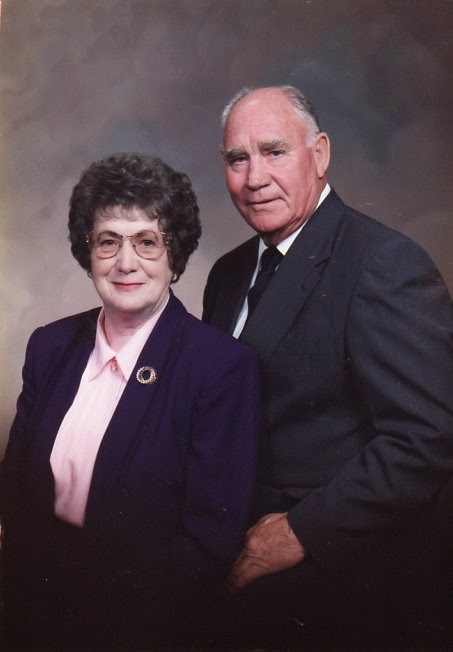
Georgia Cordingley grew up as a country girl, in a quaint little town called Marysville, Idaho, a mile east from the town of Ashton. While attending high school in Ashton, she met my grandfather—Wayne Alvin Oberhansley—who was boxing a cousin of hers during the boxing match. In the interview she says, “He really took my eye then,” but since then she’s told me a little more about the match. Apparently, Wayne was doing such a good job that she “enjoyed watching him beat the hell out of” her cousin.

He caught her eye then, but after his family moved from St. Anthony to nearby Farnum, she started to fall for him—and became good friends with his sister, Maydea. One day, the two friends wanted to go roller skating in St. Anthony. Georgia asked Wayne. Wayne’s sister, Maydea, and Georgia’s brother, Hollis, went with them. Then at the roller skating rink, Grandma and Grandpa ditched their siblings and went on a drive. They lost track of time. When they came back, the rink was already closed and it was starting to rain. Their siblings weren't happy. Oops.

Grandpa was drafted into the Marines when he was 19 and fought in World War II. (That’ll be the subject of a future blog post.) After he returned, he proposed and the two were married in 1947.

Then they started having kids.

Their first, my mother, LaDawn, was born on Mother’s Day in 1948. The second, Dennis, was born 12 months later. Then identical twins—Garth and Gary—were born about two and a half years after that, making four children under three years old. Now, I have to mention that at the time, they were dry farming and building a home next to his parents’ home near Conant Creek and Fall River. They didn't have electricity or running water yet, which means Grandma Georgia hauled water up from Conant Creek for all of their needs—including washing cloth diapers for three of the four kids. (At this point, only my mother was out of diapers.)

She says, “I had been a very fussy person who couldn't stand to have anything out of place, until I had four babies. I had to stop being so fussy. That was the happiest time of my life.”

Four years after the twins, she had another girl, Ina. Thirteen months later, she had a boy, Steve. With six children, she believed her family was complete. Then 10 years later, she found out she was pregnant again. After she welcomed Number Seven (Eric) into the family, she decided she didn't want him to grow up without a sibling to play with. (His next sibling was 10 years older!) She tried again and became pregnant.

Here’s the funny part. My mom—you know, the oldest—was already pregnant with her first. So four months after my mom gave birth to her first—Corbett—in 1969, Grandma gave birth to her last, Craig. She says, “Four months before I had Craig, we had this little gran
dson who was so adorable. I always wanted to have him out with Eric, so when I went to the hospital four months later and had Craig, I was as lonesome for Corbett as I was for Eric. When I left the hospital, I stopped and picked up Corbett, took him home, and the boys slept clear through the night. It was so fun. Corbett was just like my kid.”

Grandma was done giving birth to children, but she wasn't done raising them. When Craig was in the fourth-grade, she had the opportunity to take in a Native American foster child during the school seasons, through the Indian Placement Program of The Church of Jesus Christ of Latter-day Saints. (The program lasted from 1947 to 2000.)

She took in a boy named Jay Redfox—the same age as Craig and Corbett—who wasn't keen on the program. At first, he’d just “sit there and frown.” The first two words he spoke to Grandma were after she accidentally peeled out in the car, getting onto a paved road from a dirt road. He said, simply, “Old Buzzard peels out too.”* He took a liking to Grandpa, since he had never known his own father, but he’d only call Grandma “Hey You.” At least temporarily.

She says, “Finally, one day I said, ‘I’m not “Hey you.” You either call me Georgia, or you call me mom like the other kids!’ He just frowned at me. He went to school, and one day the phone rang, I picked it up, and Jay said, ‘Mom…’ From then on, he was my very best friend. He didn't want to go to bed; he wanted to stay up until I went to bed. He would stand and help me cook and everything.”

Grandma also took in one more Native American boy, Murray Phillips, who was a half-brother to Jay. She affectionately called them “my Indians.” She loved them as much as any parents do their own children, so when Uncle Jay died in 2012, Grandma took it the hardest. I guarantee no one in Eagle Butte, South Dakota, mourned for Jay as much as Grandma did.

Grandpa died in 2006, and shortly after that Grandma bought a smaller house in Ashton and moved away from “the ranch,” having spent most of her 59 years of marriage in that house. (Eric bought the homestead and now lives there.) To date, she has 40 grandchildren—including Jay and Murray’s children, who not only call her “Grandma” but call her up on the phone regularly. I don’t know how many great-grandchildren she has, but she even has one great-great grandchild—my niece’s daughter, Brooklyn Vega.

She may not receive any official awards in this life for being the greatest grandmother ever, but when that dreaded day comes when she’s called home to her Heavenly Father, there will be no doubt in anyone’s minds on this Earth who takes the crown.


*She actually said, “Old buzzards peel out too,” but I’m guessing there was an old woman on the reservation known (probably not affectionately) as Old Buzzard.