Wednesday, May 20, 2015

Me@20

Today marks the twentieth anniversary of an organization all of you have never heard of: The Association for Personal Historians (APH). For the past ten or so years, off and on, I’ve wanted to start my own company publishing people’s personal histories. Then I found out that the idea wasn’t original—an organization for it began when I was still a junior in high school (1995)!

To celebrate today’s twentieth anniversary, the APH has decided to start a marketing campaign called Me@20. What we want everyone to do is post a photo of yourself at age 20 and answer a few questions, telling us what life was like when you were 20. Funny anecdotes are obviously encouraged. The goal is for Me@20 to go viral today! Make sure to tag some of your friends and include the hashtag #APH20.

Let me start:


1.      Where I lived @20. I lived in Los Angeles County, being a full-time missionary for The Church of Jesus Christ of Latter-day Saints. On my 20th birthday, which was March 1, 1998, I lived in the mansion of a well-off member of the Church in Diamond Bar, California. (One of these days I’ll find photos I took of the mansion and post them. I’m not exaggerating—it was a mansion!) However, then I found myself in the ghetto-ish cities of El Monte and Baldwin Park before I ended up in Chino by the time I turned 21 in 1999.
2.      What I did @20. I would get up at 6 a.m. every morning and either study scriptures by myself, study the Missionary Guide with my companion, run around to different areas to get supplies to other full-time missionaries, or hold/attend early-morning district or zone meetings. At 9:30 a.m., we would leave our apartment and go proselyte, mostly “tracting” (knocking on doors). We’d teach people the gospel at every opportunity and baptize converts, returning to our apartment by 9:30 p.m., with lights out(ish) at 10:30. Whereas most people dread Mondays, full-time missionaries look forward to Mondays—that’s the one day a week we didn’t have to start proselyting until 6 p.m. I would sleep in until 6:30. We’d get laundry done, write letters, play basketball, and rest.
One day, while in Baldwin Park, my mother sent me a package of brand-new white shirts. The “white” shirts I still wore were stained from bleeding backpack straps and black and maroon belts. Against my nature, I decided to take part in an apostate missionary tradition—I burned my old shirts. I put them in a pile on the apartment balcony and lit them up. For a minute, I suddenly realized the stupidity of what I had done, but I managed to keep the fire contained until it burned out. When it was over, I disposed of the ashes. I never got called out on the carpet by our landlords.
3.      What I dreamt @20. I dreamt of home. No, seriously. I once dreamed of the day I could call myself a returned missionary. Other than that, I don’t remember my dreams because shortly after my head would hit the pillow, I’d find myself waking up to the alarm in the morning. I’ve never slept like that since returning from my mission.
4.      My favorite song @20. As a full-time missionary, we weren’t allowed to listen to non-mission-approved music. When I was 20, Enya was approved. That year, my favorite song was undeniably “Memory of Trees” by Enya. To this day, it still reminds me of El Monte, and I still get nostalgic over my mission.
5.      What I wore @20. Proselyting clothes consisted of a white, short-sleeved Van Heusen, a conservative tie, black slacks that could handle proselyting but wouldn’t work with a suit, and tracting church shoes—Doc Martens were not allowed on my mission. Every day.
6.      Whom I loved @20. I’ve loved only one woman my entire life; however, that year I received a letter that was kinda sorta a “dear john.” In the letter, she mentioned her “boyfriend” and then I didn’t hear from her again for many months. I humbly told myself I was happy for her, and I focused on preaching the gospel. The next year, I received a letter from her suggesting she was still single—living in Utah and going to school. In 2001, I married her. I’ve been happily married to her for the past 14 years.
7.      What made headlines when I was @20. A little blue dress.
#APH20
  
I encourage everyone to read the posts of the following personal historians: 

Clinton Haby at http://www.storykeeping.com/me20/
Jennifer Korba-Gill at http://storyboxmovies.com/news/
Dave Bloom at http://www.milestonesandmeanings.com/#!me20/c114h/555c8d480cf298b2d3cf351d

Your turn! Please answer these questions!


1. Where I lived @20:
2. What I did @20:
3. What I dreamt @20:
4. My favorite song @20:
5. What I wore @20:
6. Whom I loved @20:
7. What made headlines when I was @20:
‪#‎APH20

Monday, April 6, 2015

My Next Mountain

I teased on Facebook that I’d provide more information on the “summit” of the metaphorical mountain I had finally ascended back on March 25. It’s not the tallest peak there is, but the tallest peak I've ascended to this point in my publishing career. Now it’s time to tell you more about the climb and the view. For more background on what I’m talking about, refer to my blog post “Recording More than Just Cats” (October 28, 2014).

In a nutshell, for ten months of my LDS mission I talked about each day’s events into a tape recorder rather than writing the experiences down in a longhand journal. From 2003 to 2011, I transcribed all thirty-six hours of recordings and then edited, proofed, and added end notes to the text. In 2011, I started formatting the text in InDesign CS4. In the past twelve years I've worked on this project, there have been a few years I haven’t touched this project at all. When I have worked on it, it’s been no more than an hour at a time because of full-time employment and other conflicting priorities.


After becoming self-employed in December as a personal historian, I decided that in order for anyone—including myself—to trust me to publish anything, I'd have to have published something. I've been in the writing business for years, but I've never been the person to take a project the final steps to publication.

While at BYU, publishing opportunities slipped through my fingers in situations beyond my control. My English 318R class required me to publish a short, personal history project. After I finished it, no matter how many times I took the zip disc to the BYU Print Shop or even to Kinko’s, no one could print it. There were always problems, like missing fonts or a corrupted zip disc. In 2002, the student publication adviser chose me to be the co-editor of a student journal called Inscape: Conference Edition. Soon afterward, the English department pulled funding. Funding returned a year later—during my final semester of college, as I limped and crawled to the finish line of graduation.

While a newspaper reporter, I worked in a bureau in a separate county from the newsroom. For a single month, I worked in the newsroom. I proofed the paper each afternoon on the day prior to circulation; however, I never took part in taking it to the printer. I had a much, much larger role to play in a magazine production process at Harris Publishing; however, once again, the artist formatted the magazine and prepared it for publication, not me. That’s where my experience has stopped.

Until now.

As this year began, having taken a year or so hiatus from my missionary book project, I didn't know where I had left off. Tired of putting it together piecemeal, and while finding side jobs wherever I could, I've spent most of my time—hours per day—working on this missionary journal, which I now call My Captain’s Logs

At the beginning of February, I started proofing the entire book—five chapters and an epilogue—for the umpteenth time. I realistically cannot count how many times I've proofed this book, but I can say I've completed every step in this production process myself. I did that for the bragging rights, not because I should have.


I intentionally made this project more complicated than it needed to be, partly to give me my first taste of publishing a truly professional book, and partly for the benefit of readers unfamiliar with LDS jargon. The preface explains how the project came to be. The epilogue concludes my mission between the time the final cassette ended and when my stake president released me three days later. End notes explain details or complete events I had forgotten about while recording the captain’s logs (so that those memories won’t be lost for all mortality). The glossary explains LDS jargon and missionary culture mentioned too frequently in the text to be included in the end notes.

Starting on February 4, I devoted the entire month to proofing the main text—several hundred pages—one last time. During the proofing process, I came up with scores of new end notes for every chapter I hadn't yet written that needed including. So as to not derail my proofing, I marked each spot in the text for a new end note and continued on. Once I completed proofing the book, the day after my birthday I went back and wrote all of those missing end notes—as well as even more notes I hadn't thought of while proofing it that final time—and renumbered the end notes in the Notes section and corresponding text. I also had to confirm every cross-reference I mentioned in every chapter.

At one point I felt like Lewis Carroll's Alice, metaphorically plunging down a rabbit hole. Much like picking rock in a field while growing up on a farm, the more rocks I picked the more I found. With this, the more I corrected the more needed to be verified/corrected. Once I finished writing new end notes, I proofed the end notes. And then I proofed the glossary. Then based on the sixteenth edition of The Chicago Manual of Style (2010), I corrected front matter, back matter, general formatting, and I checked for style consistency throughout the entire Book document until I finally felt satisfied with the changes I’d made. Since the day I felt I had finally reached the summit—finishing a complicated project I started twelve years ago—I've even added a few final end notes. Just this afternoon, I even revised one end note to make it more factually accurate.

Now that I stand on this summit, feeling the cool wind on my face and enjoying the spectacular view of a completed project, I look ahead to the peak rising yet above me on the next mountain over. I've already run into hiccups on my way up the new slope—the website of a book printer based in Caldwell, Idaho, won’t even let me send them a quote request, which I've attempted several times. I’m still working on it.

My plan is to have it printed, bound, and delivered no later than the sixteen anniversary of my release from my mission (June 23). I’ll distribute those ten or so copies to family members and mission friends. Like I mentioned in my blog post in October, if you want a copy let me know. Donations will be gladly appreciated.

However, you’ll notice—after the countless hours and years of manpower I've poured into this book—it doesn't even have an index or an ISBN number.


I’m saving those for the second edition.

Tuesday, January 6, 2015

Reaching a Checkpoint

Today I reached what I thought was a milestone in my journey to publishing my first novel, only to find out it’s just a check point.

I've been working on my first novel for a few years now, tweaking it sporadically while I mainly focused on meeting magazine deadlines. Most of the time I've worked on the manuscript, I've been “perfecting” the Prologue rather than actually finishing the first draft. More than one published author has told me how foolish that is. One published author told me in 2013 that I need to know how the novel ends before I can find out how it begins. (Wrap your head around THAT!) Last November, another published author explained to me that if writing a novel is like baking cookies, the first draft is like putting all the ingredients onto the table. Once I've got all the ingredients out and the oven has been turned on, then I can start to mix the ingredients to make the cookies.

Today, I triumphantly raised both hands in the air, believing that I had finished the first draft of my first-ever novel manuscript!

My novel, the first in the Nova Chronicles series, is called A Reason to Run. It’s about a young man who lives on the planet of Elba, as part of a society divided into clans. Elba’s orbit around its star is such that the planet is habitable for three years at a time, followed by a fatally cold and uninhabitable year of winter. While the protagonist, Errol Nova, and his sister live under tyrannical rule, the theme of the novel is more about how family trumps society.

Once I reached a satisfactory climax and denouement today, my novel clocked in at 46,246 words. However, as I did some research on novel length, I found that, yes, it’s technically long enough to be considered a “novel” rather than a “novella,” but it’s more stranded between the two. It’s like in a game of Clue when you roll the dice and exit one room, having successfully pinpointed the right suspect, room, and weapon—you just need to get to the right room—but because luck wasn't a lady you’re now stuck on a square in the void where you can’t do anything but watch helplessly as your sister enters the Hall and solves the game.

In other words, the typical length of an adult novel is more like 80,000 to 90,000 words, and fantasy novels can be over 100,000 words without being considered too long. Going back to the analogy of the cookies, I've only got half of the ingredients out on the table. I guess I’d better turn off the oven.

At any rate, what I've finished writing today will be considered “Part I,” whether it’s published as a stand-alone, teaser novel or is the first half of a much larger, complete novel. That means I've got a lot of work to do revising Part I. I already know the direction I’m going to take with Part II, I just need to find where those ingredients are stashed.

Stay tuned, Elbers.

Tuesday, October 28, 2014

Recording More than Just Cats

It started with a Fisher-Price tape recorder in the 1980's, continued with a GE cassette recorder in the 1990's, and has culminated (at this point in the 21st Century) with a Sony IC digital recorder.

I've been recording stuff for most of my life.

When it was a Fisher-Price tape recorder, I recorded random things. I mean, really random. I recorded bad attempts at playing the piano. I recorded the theme during the end credits to the TV show “The A-Team.” I once accidentally recorded someone’s flatulence. (That never stopped being funny.) I even “interviewed” our pets—our bobbed-tail cat, Bobbie, and our Springer Spaniel-Australian Shepherd mix dog, Bernie. I acted like they were answering coherently.

Parenthetically, I have to mention that I lived a mile outside of a town of 1,200 people. This was before we got a Nintendo Entertainment System. We didn't have a VCR yet. There was no such thing as the Internet or smartphones. We actually used our imaginations back in the 1980's. Dang kids today.

Many years after I forgot about the Fisher-Price tape recorder, my parents gave me a gray GE tape recorder for Christmas. After once again using it to record random things—like my friends and I being stupid teenagers—I found a practical use for it while serving an honorable, full-time mission for The Church of Jesus Christ of Latter-day Saints from 1997–1999. While I wrote home to my parents nearly every week, three different times I recorded and sent a cassette letter home. That way my parents could hear my voice more often than just twice a year (Mother’s Day and Christmas).

In August of 1998, I found an even more valuable use for it. I had been keeping a written journal since December 1987. When I was nearly 10 years old, I had plenty of time but very little desire to write in it regularly; over 10 years later, it was the opposite—I had plenty of desire to write but very little time. I was serving as the “zone leader B” in the Walnut Zone of the California Arcadia Mission. That meant I was not only supposed to help the “zone leader A” with missionary work in the Orangewood Ward and Samoan wards in the Walnut California Stake, but I was also a “district leader” over two other missionary companionships and was in charge of the zone paperwork that had to be faxed weekly to the mission office in Arcadia.

My schedule reached a point where I hardly had time to write in my journal anymore. I barely had time to study the scriptures! I needed a new method of recording the day’s events and feelings, and so on Aug. 20 I resorted to using a tape recorder in lieu of a longhand journal.

For exactly 10 months to the day, I would record the day’s events—sometimes in the mornings, sometimes at night—nearly every day. I called it my “captain’s logs.” (I was and still am a Star Trek fan.) Every so often I’d miss a day or two, and so I’d have to play catch-up the next time. But I kept it up and kept purchasing blank cassette tapes—sometimes 60-minute tapes, sometimes 90-minute tapes—until my last cassette tape ran out two days before I was scheduled to return home.

While recording my captain's logs, I never concerned myself with what I was going to do with all them when I returned home. I just kept at it. When I left southern California on June 22, 1999, I had a total of 27 cassettes that were completely full—nine 60-minute tapes and eighteen 90-minute tapes, making a total of about 36 hours of recordings. At home, the longhand journals resumed.

In 2003, I finally figured out what I was going to do with all these recordings. While taking Oral History at BYU, I found a man on campus selling used transcribing machines he had fixed. I bought an old Sony industrial model—probably older than me—with a foot pedal, for $250. It’s been worth every penny.

In the 11 years since then, working on my “missionary book” has been a luxury. With most of my focus on jobs, church callings and family, there have been periods of a year or two when I wouldn't touch it. Other times, I worked on it almost daily. Over the years, I've transcribed all 27 cassettes, and edited, proofed, added end notes and proofed my missionary book again. After a long hiatus, the right time and opportunity came along in 2011 to purchase a relatively cheap but licensed copy of Adobe’s InDesign CS4. I've formatted it piecemeal, using my limited understanding of InDesign and even more limited graphic design talent. (Refer to my last blog entry. I'm the guy who only got one talent.)

As of yesterday, I’m so close to publishing it and yet so far. Yesterday, I started rearranging the end notes from where I had placed them at the end of each chapter to the back of the book (per the fourteenth edition of the Chicago Manual of Style). To those of you who know InDesign, that means I have a lot of residual problems that now need to be fixed. I also have to finish the front matter and add back matter, such as an index. At this point, this monstrosity is already approaching 500 pages. 

It’s not the kind of book you publish to sell; I’m publishing it so I can have that 10 months of my life on paper and so I can finally understand the entire publishing process—from raw manuscript to polished book. When it’s finally published, I’m only going to print about 10 copies or so. If I interacted with you as a missionary in the California Arcadia Mission, you may want to order an advanced copy from me. Because I probably talked about you.

But I promise I never recorded anyone’s flatulence.

Tuesday, October 14, 2014

Where Did I Put My Talent?


Go Ye Therefore and Teach All Nations, LDS.org.
In the New Testament, the Savior Jesus Christ taught his disciples a parable about “talents,” which in this case meant a unit of weight as well as a large sum of money. The Savior had spent the bulk of the previous chapter (Matt. 24) explaining some of the alarming signs and calamities preceding his Second Coming—alarming for us living in the 21st Century because of how relevant to our society the warnings are.

After spelling out what must have sounded more like the emphasis was on the “dreadful” than “great” in the “coming of the great and dreadful day of the Lord” (as described by Malachi), the Savior then gave his disciples some hope. He taught them parables about the weeding-out process—the five wise virgins from the five foolish, the sheep from the goats, and the wise servants and their talents from the foolish servant.

In the parable, a man about to travel abroad hands out talents to three of his servants—five to one servant (let’s name him Joseph), two to another (let’s name him Nathanael) and one to another (let’s name him Judas). While the master is gone, Joseph and Nathanael take those talents and, by trading with others, double them. Judas, meanwhile, buries his one talent. Literally.

“After a long time” the master returns and “reckoneth” with the servants. After all, the money didn't belong to the servants; the talents belonged to him. Since he was out of the country on business and couldn't increase his earnings, he gave his servants stewardship over some of his talents—trusting them with a lot of money—to do something with on his behalf.

Photo from PersonalFinanceJourney.com.
No surprise, Joseph is rewarded for doubling five talents into ten—after all, he earned as much money as Nathanael and Judas had on them combined! The master then piles on the praise by saying, “Well done, thou good and faithful servant: thou hast been faithful over a few things, I will make thee ruler over many things: enter thou into the joy of thy lord” (Matt. 25:21).

Then it’s Nathanael’s turn. He received two—only one more than Judas—but he also chose to double what he had received. While Nathanael’s final sum is only 40 percent of Joseph’s, he receives the same reward—the master says the same thing to him verbatim (except for one word) as he had to Joseph.

Finally it’s Judas’ turn, his talent still buried. No doubt the reason he hadn't retrieved it once he heard his master had returned—since this is a parable about being prepared for the Second Coming—was because he was caught completely off guard and didn't have time. Instead, he was left to do the only thing many procrastinators choose to do when time is officially up—make excuses. Judas even goes so far as to blame his master as being the reason it was buried—no introspection, no humility, no “Lord, is it I?” attitude. As a result, what he had been given was taken away from him, leaving Judas with the inevitable “weeping and gnashing of teeth” of regret at having squandered an opportunity.

Was it fair that Judas only received one talent? According to Matt. 25, the master didn't distribute the talents randomly. In verse 15, it states the master handed them out “to every man according to his several ability.” In other words, he gave five talents to Joseph knowing he’d double them. It’s possible that Nathanael wasn't as “talented” as Joseph, but the master knew the potential was there. So he tested him with an extra talent—and Nathanael came through. Judas’s bar was apparently set pretty low. Much like with Cain in Gen. 4:7, all the Lord required was, “If thou doest well, shalt thou not be accepted?” That was it—just do something with it. And yet that was apparently asking too much.

I work from home, and so I take the occasional break from my basement office by going upstairs and letting the rays of the sun re-energize me Superman-style. This morning, while at the kitchen table, I glanced out our sliding back door and saw the sixth-graders at Ucon Elementary running the mile around the track. It was apparent they had just started since all of them were close together in single file. It didn't take long for everyone to start spreading out—each kid “according to his [or her] several ability.”

While I admired the kids in front for their speed, I noticed the kids straggling behind. One boy appeared to have a limp, but he was still jogging. The boy in the back was walking, albeit you could tell he was putting forth some effort to be quicker. Ignoring the kids in front—because I knew the teachers would shower plenty of praise on them—all I could think of watching some of the straggling boys was, “Don’t give up, kid.”

Photo from MapMyRun.com.
From personal experience—as the kid who always finished third-from-the-last in running the mile in school—I wanted to run out to the fence next to the track and shout encouragement to the stragglers. I wanted to tell them not to compare themselves to the kids in the front (and I wanted to tell the kids in the front to do the same thing to the kids behind them). I hated running while growing up, but it’s now growing on me as a thirty-six-year-old. This last year, I reached a milestone of running six miles without stopping, and I participated in two 5K's—making it into the top ten both times. I don't care that that may sound slow to many people. It's something to me.

We live in a world where others are quick to judge and compare and condemn. It’s frustratingly easy to get caught up in comparing ourselves to others, when what you need to do is compare Present Self with Past Self. Regularly. If you find yourself lacking, you step up your game. You push a little harder today and focus on keeping up that level until you find you have strength to push yourself a little harder. Then the next time you compare Present Self to Past Self, you’ll find your talents have increased.

You may even find they've doubled.

Tuesday, October 7, 2014

"I'm Going to Get It"

“April 4, Academy Awards. I made it. Looking across the orchestra, just before Susan [Hayward] read it off, something popped in my head. 'I’m going to get it.' And I did. I kissed Lydia and walked to the stage dripping wet, except for a pepper-dry mouth: classic stage fright. I’ll never forget the moment, or the night, for that matter. Backstage, posing beside Willy with his third Oscar, I said, 'I guess this is old hat for you.' 'Chuck,' he said, 'it never gets old hat!'"
-Charlton Heston, April 4, 1960 (Charlton Heston: The Actor's Life, Journals 1956–1976)


Charlton Heston in Ben-Hur. Photo from Photofest.
In the late 1970's, Charlton Heston was convinced by a friend to publish the work journal he had been keeping for the past two decades. It's called Charlton Heston: The Actor's Life, and is essentially a two-decade compilation of his equivalent to Facebook status updates—daily tidbits of "a hundred words or so" written at the bottom of an appointment book given to him by his wife as a Christmas gift. Unfortunately for us, he started the journal while wrapping up The Ten Commandments. Fortunately for us, there were many other movies he worked on during the next two decades—including Ben-Hur, which earned eleven Academy Awards out of twelve nominations (a feat that wasn't duplicated until 1997 and 2003, with Titanic and the Lord of the Rings: Return of the King, respectively).

Reading through his published journal, I’m finding it’s hard to find an entry to spotlight in a blog because there are so many little snippets in his life that would make great blog posts. So I’m going to shoehorn some of these snippets from a one-month period—with both ups and downs.

On March 30, 1960, Heston and his wife, Lydia, attended the premiere of Ben-Hur at Tokyo Theater. MGM had been begging Heston to attend, even though the film was doing fine. As a matter of fact, they were only days away from the 32nd Academy Awards. However, the emperor of Japan himself—as well as the empress and the crown prince—were planning on attending. The emperor had never so much as set foot on the Ginza, Tokyo’s version of Broadway. According to Heston in his autobiography, In the Arena, he was compelled to attend “for the protocol of the thing.” But he adds, “We were happy to go along with that.”

The trip to Japan, with stops in Seattle and Alaska, brought back memories of serving in the army in World War II, according to Actor’s Life. He says, “To be in Alaska again still shrouded me in the melancholy of a twenty-year-old at war and far from home.” While the bombing of Hiroshima and Nagasaki ended planned invasions of Japan that Heston could possibly have taken part, 1960 was Heston’s invasion.

And the Japanese more than welcomed him. He says that the restaurants were “fabulous” and the people were “wonderfully friendly.” The theater had been redecorated—inside and out—and new projectors had been installed, which, of course, gave Murphy’s Law an invitation to crash the party. He recalls in Arena that the film broke “three times in the first ten minutes.” He had to stop Jim Castle, head of MGM distribution for the Far East, from rushing up to the projection booth, “clearly bent on murder.” However, once Castle saw the “corpse-pale” projectionist’s face, he observed there was nothing he could do to make the man feel worse than he already did.

Chuck and Lydia Heston with Jimmy and Gloria Stewart at the 32nd Academy Awards. Photo from Charltonhestonworld.homestead.com.
In spite of the hiccups, the premiere itself went well, but things weren't going so well at home in America. Heston states in his journal that the trip was interrupted the first day by a call no one wants to get—Lydia’s mother had had a heart attack. He says his wife took it well, and the day, for the most part, progressed as planned until she boarded a plane at midnight to fly home. When he arrived in Los Angeles on April 2, he says his mother-in-law seemed “past her crisis.”

Two days later, Charlton Heston would be on top of the world at the 32nd Academy Awards. According to Heston in Arena, the long night began while he strolled into the lobby. It just happened to be at the same time as Jimmy Stewart, the Best Actor nominee for Anatomy of a Murder. After the media went crazy taking photos of the two nominees together, Jimmy took Heston’s arm and said, “I hope you win, Chuck. I really mean that.” Heston states, “He did, too. I don’t know another actor alive who would've said such a thing. He’s an extraordinary man.”

Photo from Charltonhestonworld.homestead.com.
Several hours later, while Susan Hayward reached for the envelope for Best Actor, Heston says he had “an odd experience.” He says he felt, while glancing to his left at a chandelier at the other side of the hall, an “almost audible click” that he had won. He says he sat with perfect equanimity until Susan read his name. During the course of his acceptance speech, he thanked an uncredited contributor, writer Christopher Fry—which annoyed the Writers Guild. (They had refused MGM give credit to Fry on the movie.) While taking pictures afterward with Ben-Hur director William Wyler—“Willy” in the journal entry—he realized receiving an Academy Award never gets “old hat.”

After the show, he and his wife first stopped at the hospital to show Lydia’s mother the Oscar, and then they moved from party to party “all night long.” He says, “Though I drank, I’m afraid, more or less steadily until we got home at dawn and sat on the front steps to savor the L.A. Times’ front page, I was stone cold sober.”

The rest of the month was certainly incidental, but there isn't the room for it in this blog. I will mention, however, that he subsequently received a rebuking letter from the Writers Guild for mentioning Fry in his acceptance speech (an “entertaining controversy,” he adds in his journal). He also participated with the negotiating committee in the Screen Actors Guild strikes, led by none-other-than our future fortieth president, Ronald Reagan. The month of April did not end on a happy note, unfortunately. On April 30, while rehearsing for The Ed Sullivan Show in New York City, he received a call from Lydia that her mother had passed away.


Heston mentions in the introduction to Actor’s Life that because of his journals, "I still don't have many answers, but I've got better questions. The journals have taught me a lot... But the main thing I've learned is this: It's not always the way you remember it was."

Tuesday, September 30, 2014

My Grandma is Better than Your Grandma

On Nov. 30, 2002, I conducted my very first interview. It wasn't as a newspaper reporter or as a magazine editor—I've conducted countless hours of those interviews since. This one was special, not only because it was my first, but because the subject was my maternal grandmother—Georgia Cordingley Oberhansley.

It was during the Thanksgiving break prior to my last semester at Brigham Young University. I had found out earlier that month that one of the options for Senior Courses the next semester—among mind-numbing literature classes and linguistics classes—included Oral History. Even though I had never tasted of oral history before, it had jumped out at me so fiercely that I scheduled an interview before the semester even started.

(As it turns out, that was a smart idea anyway. Since my grandmother was over 300 miles away from campus—and because there isn't ONE SINGLE day off from classes during BYU's Winter semesters because they have to pack so many events on campus after the Winter semester concludes and before the next Fall semester ends—that I couldn't have interviewed her in person after the semester started. Sorry. Rant over.)

Grandma Georgia didn't divulge very many details during that interview, but she told me a lot more than I had heard before. While I had always loved and adored Grandma Georgia, after the interview was over I almost worshiped her. I literally have the greatest grandmother in the world. Anyone who says different is wrong. Here’s why:

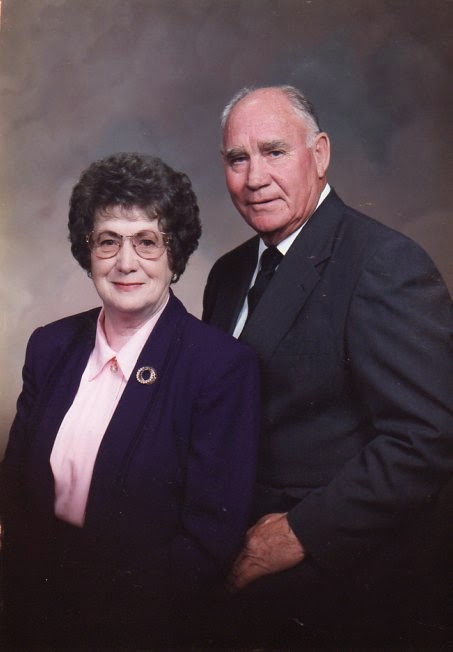
Georgia Cordingley grew up as a country girl, in a quaint little town called Marysville, Idaho, a mile east from the town of Ashton. While attending high school in Ashton, she met my grandfather—Wayne Alvin Oberhansley—who was boxing a cousin of hers during the boxing match. In the interview she says, “He really took my eye then,” but since then she’s told me a little more about the match. Apparently, Wayne was doing such a good job that she “enjoyed watching him beat the hell out of” her cousin.

He caught her eye then, but after his family moved from St. Anthony to nearby Farnum, she started to fall for him—and became good friends with his sister, Maydea. One day, the two friends wanted to go roller skating in St. Anthony. Georgia asked Wayne. Wayne’s sister, Maydea, and Georgia’s brother, Hollis, went with them. Then at the roller skating rink, Grandma and Grandpa ditched their siblings and went on a drive. They lost track of time. When they came back, the rink was already closed and it was starting to rain. Their siblings weren't happy. Oops.

Grandpa was drafted into the Marines when he was 19 and fought in World War II. (That’ll be the subject of a future blog post.) After he returned, he proposed and the two were married in 1947.

Then they started having kids.

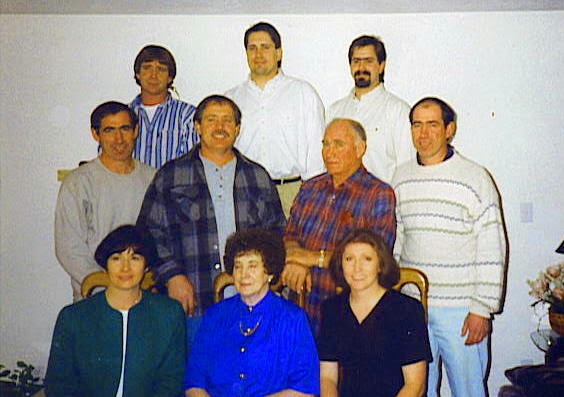
Their first, my mother, LaDawn, was born on Mother’s Day in 1948. The second, Dennis, was born 12 months later. Then identical twins—Garth and Gary—were born about two and a half years after that, making four children under three years old. Now, I have to mention that at the time, they were dry farming and building a home next to his parents’ home near Conant Creek and Fall River. They didn't have electricity or running water yet, which means Grandma Georgia hauled water up from Conant Creek for all of their needs—including washing cloth diapers for three of the four kids. (At this point, only my mother was out of diapers.)

She says, “I had been a very fussy person who couldn't stand to have anything out of place, until I had four babies. I had to stop being so fussy. That was the happiest time of my life.”

Four years after the twins, she had another girl, Ina. Thirteen months later, she had a boy, Steve. With six children, she believed her family was complete. Then 10 years later, she found out she was pregnant again. After she welcomed Number Seven (Eric) into the family, she decided she didn't want him to grow up without a sibling to play with. (His next sibling was 10 years older!) She tried again and became pregnant.

Here’s the funny part. My mom—you know, the oldest—was already pregnant with her first. So four months after my mom gave birth to her first—Corbett—in 1969, Grandma gave birth to her last, Craig. She says, “Four months before I had Craig, we had this little gran
dson who was so adorable. I always wanted to have him out with Eric, so when I went to the hospital four months later and had Craig, I was as lonesome for Corbett as I was for Eric. When I left the hospital, I stopped and picked up Corbett, took him home, and the boys slept clear through the night. It was so fun. Corbett was just like my kid.”

Grandma was done giving birth to children, but she wasn't done raising them. When Craig was in the fourth-grade, she had the opportunity to take in a Native American foster child during the school seasons, through the Indian Placement Program of The Church of Jesus Christ of Latter-day Saints. (The program lasted from 1947 to 2000.)

She took in a boy named Jay Redfox—the same age as Craig and Corbett—who wasn't keen on the program. At first, he’d just “sit there and frown.” The first two words he spoke to Grandma were after she accidentally peeled out in the car, getting onto a paved road from a dirt road. He said, simply, “Old Buzzard peels out too.”* He took a liking to Grandpa, since he had never known his own father, but he’d only call Grandma “Hey You.” At least temporarily.

She says, “Finally, one day I said, ‘I’m not “Hey you.” You either call me Georgia, or you call me mom like the other kids!’ He just frowned at me. He went to school, and one day the phone rang, I picked it up, and Jay said, ‘Mom…’ From then on, he was my very best friend. He didn't want to go to bed; he wanted to stay up until I went to bed. He would stand and help me cook and everything.”

Grandma also took in one more Native American boy, Murray Phillips, who was a half-brother to Jay. She affectionately called them “my Indians.” She loved them as much as any parents do their own children, so when Uncle Jay died in 2012, Grandma took it the hardest. I guarantee no one in Eagle Butte, South Dakota, mourned for Jay as much as Grandma did.

Grandpa died in 2006, and shortly after that Grandma bought a smaller house in Ashton and moved away from “the ranch,” having spent most of her 59 years of marriage in that house. (Eric bought the homestead and now lives there.) To date, she has 40 grandchildren—including Jay and Murray’s children, who not only call her “Grandma” but call her up on the phone regularly. I don’t know how many great-grandchildren she has, but she even has one great-great grandchild—my niece’s daughter, Brooklyn Vega.

She may not receive any official awards in this life for being the greatest grandmother ever, but when that dreaded day comes when she’s called home to her Heavenly Father, there will be no doubt in anyone’s minds on this Earth who takes the crown.


*She actually said, “Old buzzards peel out too,” but I’m guessing there was an old woman on the reservation known (probably not affectionately) as Old Buzzard.